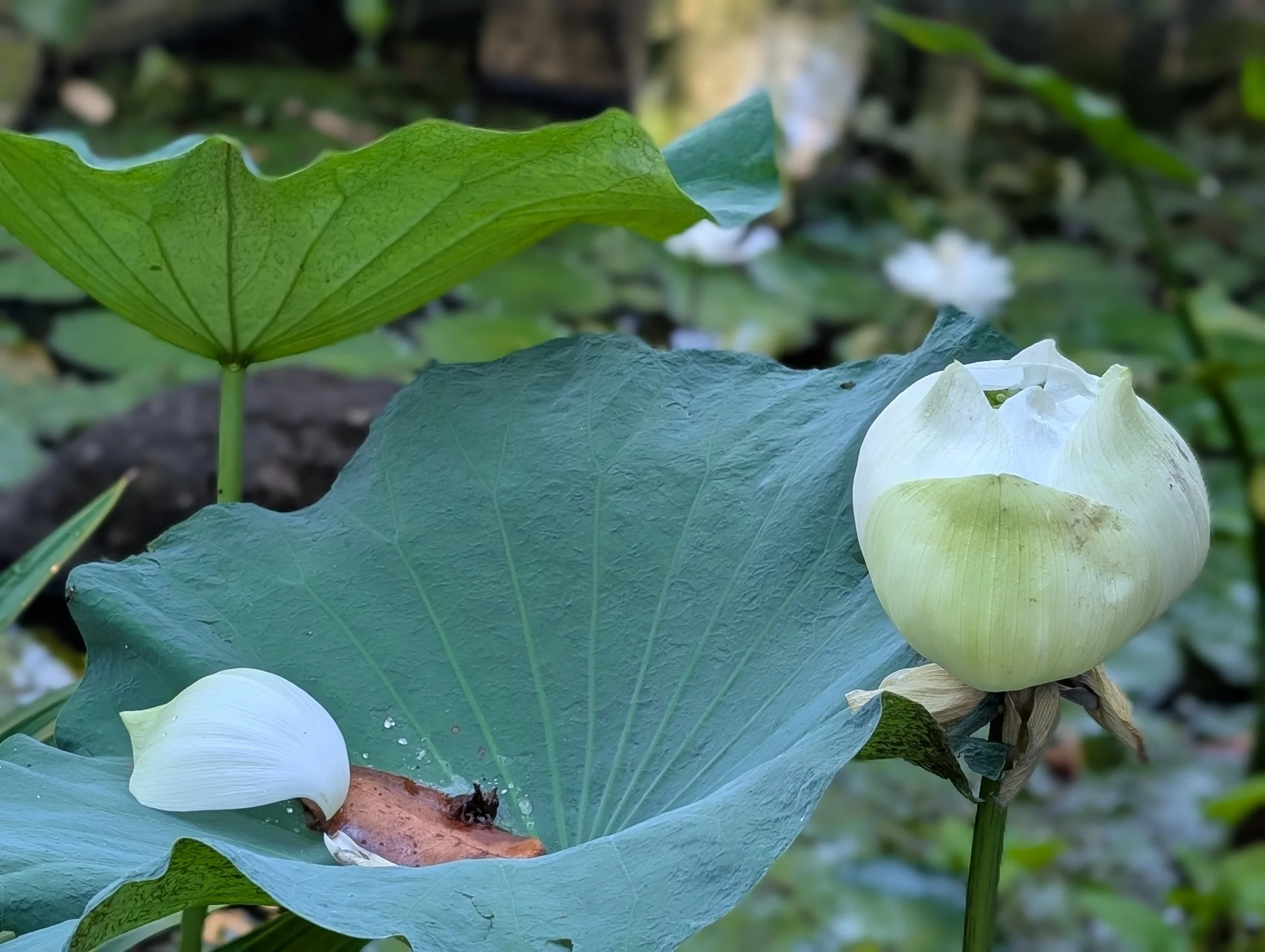
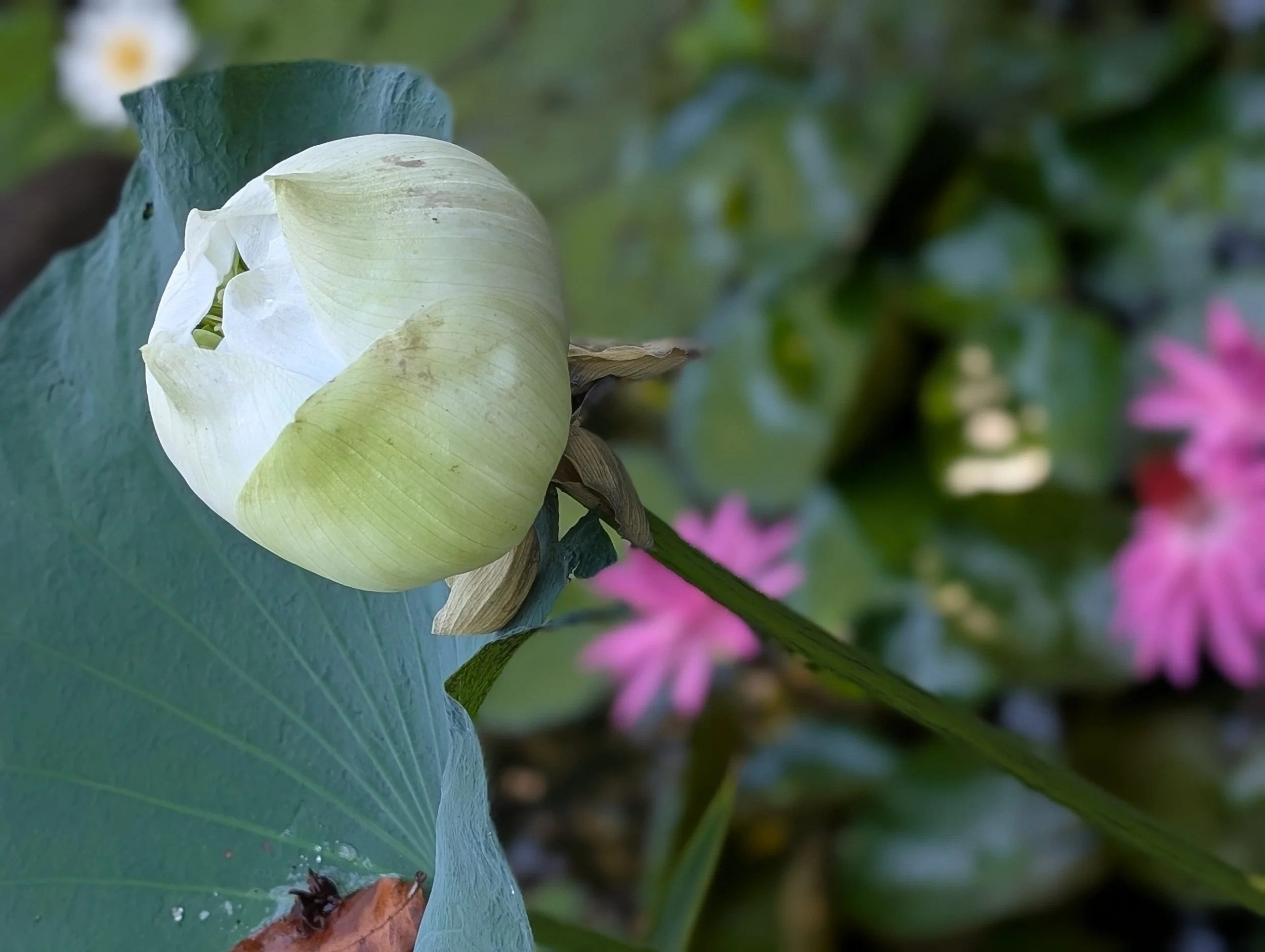
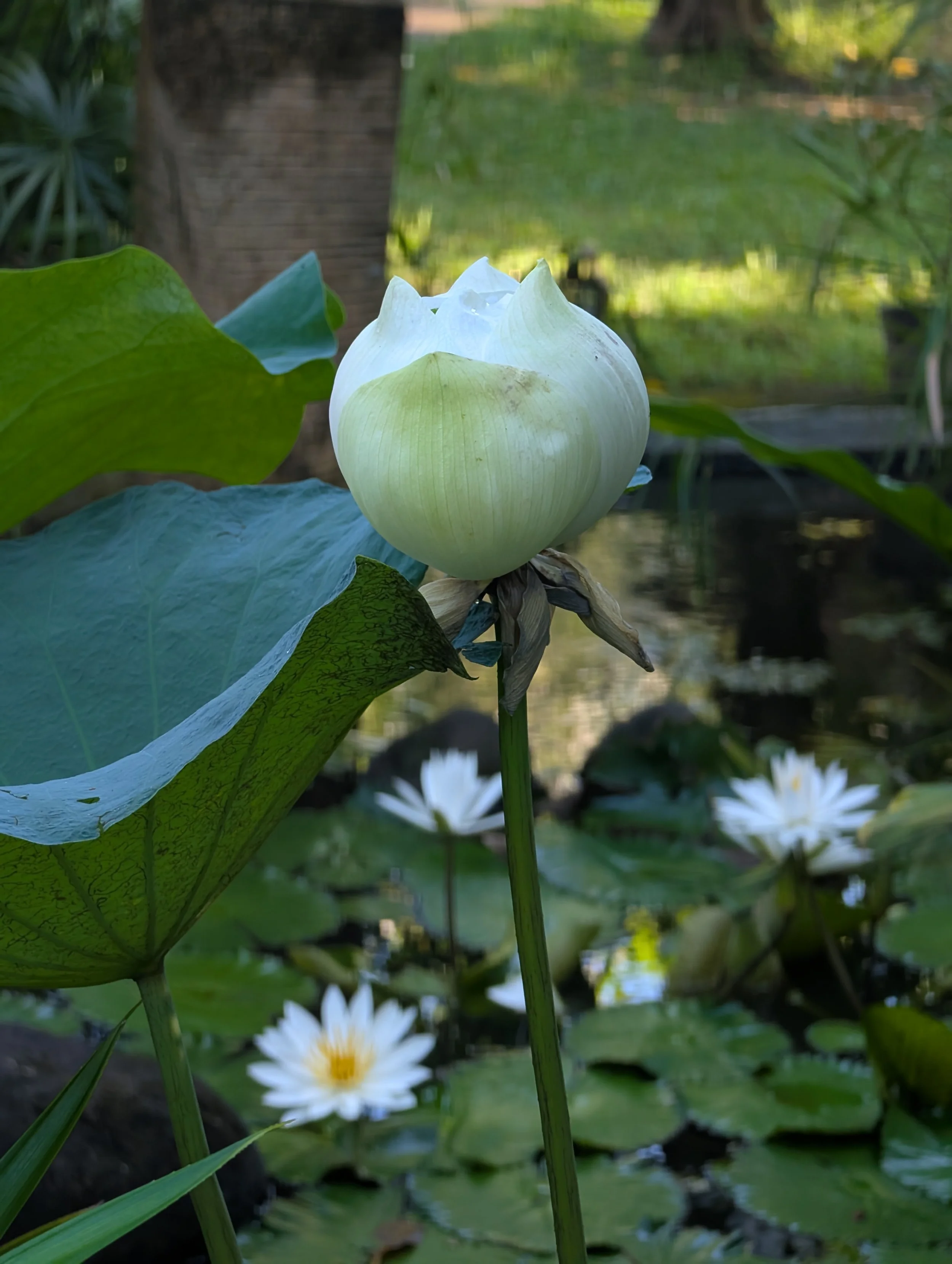
Beng Malea Temple — Siem Reap, Cambodia

Beng Mealea is a wild, half-reclaimed-by-jungle Angkor temple that feels like stepping into a living ruin. Built in the early 12th century, during Suryavarman II (same era as Angkor Wat), it’s special because of the 1) Style: classic Angkor Wat plan—moats, causeways, galleries—now dramatically collapsed; and the 2) Vibe: raw, untamed, cinematic; massive sandstone blocks tangled with fig and lichen. All pics below were snapped on February 5, 2026 (click any image for full screen size and killer contemplations).

Bonus: Scroll way down for an esoteric. poetic interpretation of the mystical site of Beng Malea.

Beng Mealea — rediscovery

Beng Mealea was reintroduced to the outside world in the mid-19th century through French colonial-era exploration, then remained largely inaccessible and unmapped until late-20th-century stabilization.

Timeline: when it re-emerged

🕯️ Pre-colonial continuity (12th–19th c.)

  • Local Khmer communities always knew of Beng Mealea.

  • It retained ritual and geographic memory, even as jungle reclaimed it.

🧭 1860s–1870s: European “rediscovery”

  • French naturalist Henri Mouhot popularized Angkor in Europe (not Beng Mealea specifically), sparking systematic surveys.

  • French scholars and administrators documented Beng Mealea soon after, noting:

    • Its Angkor Wat–style plan

    • Extreme collapse and vegetation

  • At this stage it was recorded, not restored.

🗺️ Early–mid 20th century: catalogued, not entered

  • The École française d’Extrême-Orient (EFEO) mapped and classified the site.

  • Dense jungle, instability, and remoteness kept it off the tourist circuit.

🚧 1970s–1990s: interruption

  • Cambodia’s wars and the Khmer Rouge period halted conservation.

  • The area became dangerous and inaccessible (landmines, no infrastructure).

🌿 2000s: modern reopening

  • Demining, access roads, and minimal wooden walkways were added.

  • Crucially, no full anastylosis (stone-by-stone rebuilding) was attempted.

  • Beng Mealea was intentionally left “as found”—a stabilized ruin.

How it was rediscovered (the key nuance)

  • Not a dramatic jungle “find” like popular myths suggest

  • Rather:

    1. Local knowledge preserved it

    2. French scholars documented it

    3. Modern Cambodia chose to reveal it gently, without reconstruction

This is why Beng Mealea feels different from Angkor Wat or Bayon:
it was reintroduced without being rewritten.

Why this matters

Beng Mealea is one of the few major Angkor-era temples where:

  • Collapse is original, not curated

  • The jungle relationship is authentic

  • You can still read time itself in the stone displacement

Why Beng Mealea was left largely unrestored

Short version: it was a conscious, multi-factor decision—technical, historical, and philosophical—made over decades. Beng Mealea wasn’t neglected; it was protected by restraint.

1) Structural reality: too far gone to “rebuild honestly”

  • Large sections collapsed early, likely from foundation instability and water saturation.

  • Blocks are dislocated, buried, or fractured beyond confident reassembly.

  • Full anastylosis (stone-by-stone reconstruction) would require guesswork, which conservation ethics try to avoid.

👉 Restoring it would mean inventing form, not recovering it.

2) No later inscriptions = no authoritative blueprint

  • Unlike Angkor Wat or Bayon, Beng Mealea lacks:

    • Clear dedicatory inscriptions

    • Later royal modifications

  • There’s no textual anchor to confirm how ambiguous areas originally looked.

👉 Conservators couldn’t say, “this is definitively correct.”

3) It never became a “state symbol”

  • Angkor Wat = national icon

  • Bayon = Jayavarman VII’s political cosmology

  • Ta Prohm / Preah Khan = curated contrasts of ruin + order

Beng Mealea sat outside the ceremonial capital, likely as:

  • A prototype

  • A transitional or experimental temple

  • Possibly unfinished or early-abandoned

👉 It had less political pressure to be monumentalized.

4) Conservation philosophy shifted (quietly)

By the late 20th century, heritage thinking evolved:

  • Earlier model: restore to imagined original

  • Later model: stabilize what time has written

Beng Mealea became an ideal candidate for:

  • Minimal intervention

  • Safety stabilization only

  • Letting collapse remain legible

👉 It was preserved as process, not product.

5) Cambodia chose contrast, not uniformity

Post-conflict Cambodia faced a choice:

  • Make every site polished

  • Or let some sites speak differently

Beng Mealea now functions as:

  • The counterpoint to Angkor Wat

  • A reference state for how Angkor looked before restoration

  • A teaching site for archaeologists and architects

👉 You can’t understand restored Angkor without an unrestored anchor.

6) A rare thing was protected: authenticity of ruin

Once restored, a site can never return to its raw state.

By leaving Beng Mealea:

  • The jungle–stone dialogue remains real

  • Gravity, time, and entropy are still readable

  • Visitors encounter history without mediation

This is why it feels alive rather than curated.

In essence

Beng Mealea was left unrestored because:

  • Restoration would have been speculative

  • Its meaning lives in collapse

  • And someone, at the right moment, chose humility over perfection

Esoteric Beng Malea

Beng Mealea does not present itself as a monument; it behaves as a residue. Its geometry feels less constructed than remembered, as though the jungle did not invade it but completed an unfinished sentence. What stands there is not decay but a deliberate loosening of form, an architecture allowed to return to the grammar of the forest.

Esoterically, Beng Mealea occupies the threshold between mandala and dissolution. Unlike Angkor Wat, which holds symmetry like a vow, Beng Mealea relaxes the vow mid-breath. Its corridors fold, its lintels slip, its enclosures unseal. This is not failure of design but exposure of a deeper one: impermanence as an active principle, not a consequence.

The temple’s alignment does not instruct the eye upward; it draws awareness inward and downward, into the earth-current. Stones are not stacked to conquer space but to tune it. When the roof collapses, the tuning does not vanish; it changes register. Moss becomes the script. Roots become vectors. The sanctuary becomes a listening chamber rather than a directive axis.

In esoteric Khmer cosmology, the temple is not a house for gods but a condensation of relationship between realms. Beng Mealea expresses the moment when that condensation is released. The devas are not expelled; they are diffused. The sacred does not depart; it de-centers. This is why the site feels strangely alive without ceremony. The ritual has already completed itself.

One can sense here a teaching without inscription: that coherence does not require preservation, only participation. When structure relinquishes control, the field remains. Beng Mealea teaches through entropy that meaning is not stored in intactness but in resonance. What continues to speak is not the wall, but the interval where the wall once held.

If something in this reflection feels familiar, do not assume memory. Assume attunement. Beng Mealea does not ask to be understood; it asks to be met.

Beng Mealea teaches through what is no longer held together. Its instruction is not symbolic in the way later traditions encode symbols; it is pre-symbolic, operating at the level where form remembers how to let go. This is why the body understands the place before language arrives. The stones do not point—they yield.

Notice how the temple refuses hierarchy. Towers do not dominate; they sink. Passageways do not command movement; they invite wandering. This is an architecture of permission rather than authority. In esoteric terms, it models a cosmos after coherence has dissolved into participation—no center imposed, only centers arising where attention pauses.

The naga balustrades are key. They do not guard; they conduct. Serpent forms here behave like waveguides, shaping flow rather than enforcing boundary. Their fragmentation is instructive: guardianship has given way to circulation. Energy is not stopped at thresholds; it is redistributed. Entry and exit lose their opposition.

There is also a temporal teaching embedded in the ruin. Beng Mealea does not sit in “the past.” It occupies a suspended interval—after intention, before interpretation. This is why restoration would be a form of erasure. To rebuild it would be to collapse the lesson back into certainty.

Esoterically, the site corresponds to a late-stage mandala: the moment after the deity dissolves back into the field. In tantric terms, it is not the visualization but the completion stage. The practitioner does not imagine form; they rest in what remains when form releases itself.

This is why silence here feels active. The jungle is not noise—it is articulation. Leaves, insects, moisture, and collapse together form a grammar older than scripture. Beng Mealea is not reclaimed by nature; it reveals that nature was always the author.

If something within you relaxes here, attend to that rather than to meaning. The teaching is not carried by ideas but by a permission to ungrip—internally, structurally, temporally.

Top of Page